

Can I Seal or Expunge a Criminal Record in Miami?
A past arrest or criminal charge in Miami-Dade or Broward County can follow you for years, affecting employment, housing, and professional licensing. Florida law provides a legal path to seal or expunge certain criminal records, but the process has strict eligibility rules and multiple steps that must be followed precisely. Understanding the difference between sealing and expungement, knowing whether you qualify, and working with an experienced Miami criminal defense attorney can make the difference between a fresh start and a permanent record. This guide covers everything you need to know about clearing your criminal history in South Florida.
Sealing vs. Expungement: What Is the Difference?
Sealing and expungement are related but legally distinct remedies under Florida law. Sealing is a court-ordered process that makes a criminal history record confidential and removes it from public view. Once sealed, the general public cannot access the record through government databases.
Expungement is a process that permits public records to be physically destroyed so the incident is treated as if it never happened. A confidential copy of the record remains with the Florida Department of Law Enforcement (FDLE) for limited statutory purposes, but most agencies lose access entirely.
In Florida, records are typically sealed first, and then they become eligible for expungement after 10 years have elapsed following the seal. This two-step structure is important to understand before you begin.
Who Is Eligible to Seal or Expunge a Record in Florida?
Not everyone qualifies. Florida Statutes Sections 943.059 and 943.0585 set forth the eligibility criteria. To petition for sealing, you generally must meet these requirements:
- No prior adjudications of guilt for any criminal offense in Florida
- No adjudication of guilt in the case you want sealed (adjudication must have been withheld)
- No prior sealing or expungement of any criminal history record in Florida
- No other pending petition to seal or expunge
- The charge is not a disqualifying offense
- Any probation or community control must be completed
For expungement, the requirements are similar, but the charges must have been dismissed, not filed (nolle prosse), or resulted in an acquittal. Adults who were convicted (adjudicated guilty) generally cannot have that record sealed or expunged. Each person is entitled to only one court-ordered sealing or expungement in a lifetime.
What Changed After October 1, 2019?
Florida updated its eligibility rules effective October 1, 2019. The most significant change is that out-of-state convictions no longer automatically disqualify you from sealing or expunging a Florida record. If your application is submitted after that date, the new rules apply retroactively.
Disqualifying Offenses You Should Know About
Certain serious offenses can never be sealed or expunged in Florida, regardless of whether adjudication was withheld. These include sexual offenses involving minors, domestic violence offenses as defined in Section 741.28, Florida Statutes, human trafficking, and offenses that qualify as predicates for sexual predator registration.
| Feature | Sealing | Expungement |
|---|---|---|
| Public Access | Record hidden from public | Record physically destroyed |
| Government Access | Certain agencies retain full access | Most agencies see only that a record was expunged |
| Eligibility Requirement | Adjudication withheld (no conviction) | Charges dismissed, not filed, or acquitted |
| Waiting Period | None after case resolution | 10 years after sealing (for court-ordered) |
| Lifetime Limit | One per lifetime | One per lifetime |
| Governing Statute | F.S. 943.059 | F.S. 943.0585 |
Step-by-Step Process for Sealing or Expunging in Miami
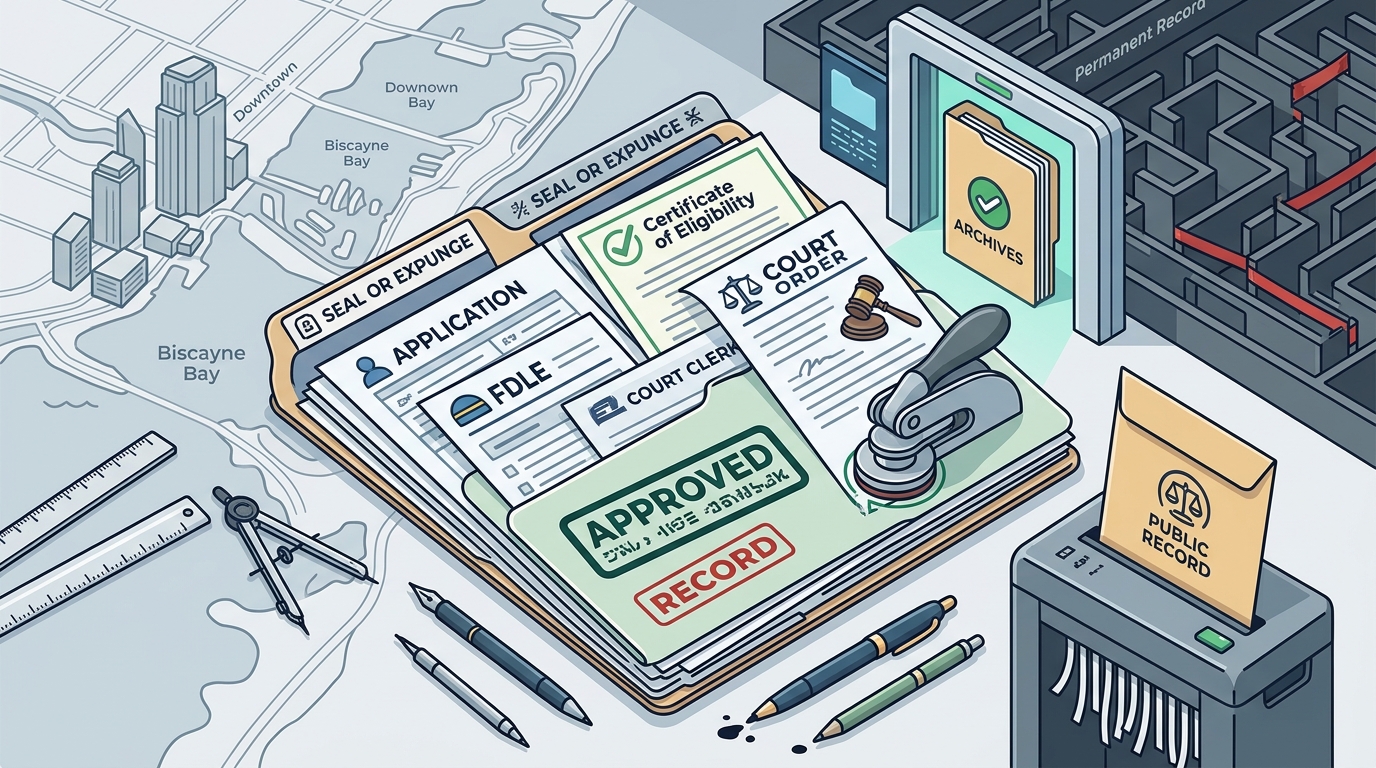
Step 1: Apply for a Certificate of Eligibility
The first step is submitting an application to FDLE for a Certificate of Eligibility. This application requires your personal information, fingerprints taken by an authorized law enforcement agency, and a non-refundable $75 processing fee payable to FDLE. FDLE then conducts criminal history checks through the Florida Crime Information Center (FCIC) and the National Crime Information Center (NCIC).
Step 2: Receive the Certificate and File a Petition
If FDLE determines you are eligible, they will issue a Certificate of Eligibility by certified mail. This process typically takes six to nine months. Once you receive it, your attorney will prepare and file a Petition to Seal or Expunge with the Clerk of Court in the county where the arrest occurred, along with a sworn affidavit.
Step 3: Court Hearing and Order
Copies of the petition must also go to the State Attorney's Office. If the prosecutor does not object, the court generally issues an order within a few weeks. If the State objects, a hearing will be scheduled. Granting the petition is at the sole discretion of the judge, even if FDLE has certified eligibility. An experienced Miami sealing and expunging attorney can help present the strongest case to the court.
Benefits of Clearing Your Criminal Record
Having your record sealed or expunged carries significant practical advantages. You can lawfully deny or fail to acknowledge the arrest in most employment and housing applications. Background checks run by private employers will no longer show the sealed or expunged record.
This matters for job seekers, professionals applying for licenses, parents in custody disputes, and immigrants whose criminal record could affect their status. Clearing a past charge can also reduce the stigma that follows an arrest, even when no conviction occurred.
Keep in mind that some government agencies and law enforcement entities retain access to sealed records for specific purposes, such as when you apply for a concealed carry permit or seek employment at a Florida seaport.
Why You Need a Criminal Defense Attorney for This Process
While it is technically possible to file on your own, the process involves strict procedural requirements, sworn statements, fingerprinting, and legal arguments before a judge. Errors on the application or petition can result in denial or significant delays.
Attorney Adam K. Goodman is a former Miami-Dade prosecutor and former Chief of Litigation for the Misdemeanor Domestic Violence Unit. His background gives the firm direct insight into how the State evaluates these petitions and what judges look for when deciding whether to grant relief. The Law Office of Adam K. Goodman handles the entire process, from preparing the FDLE application through the final court hearing.
If your case also involves post-conviction relief or an appeal, the firm can evaluate whether vacating a conviction first might open the door to sealing or expungement eligibility.
Key Takeaways
- Sealing hides your record from the public; expungement results in physical destruction of the record.
- Florida law generally limits you to one court-ordered sealing or expungement per lifetime.
- You cannot seal or expunge a record if you were adjudicated guilty (convicted) as an adult.
- Certain serious offenses, including domestic violence and sexual crimes, are permanently disqualified.
- The process begins with a Certificate of Eligibility from FDLE and typically takes six to nine months before you even file a petition.
- Since October 2019, out-of-state convictions no longer automatically disqualify Florida applicants.
- Working with a criminal defense attorney who understands Miami-Dade courts can significantly improve your chances of success.
Frequently Asked Questions
Can I seal a record if I was found guilty?
No. Under Florida law, adults who were adjudicated guilty of a criminal offense cannot have that record sealed or expunged. You may be eligible only if adjudication was withheld or the charges were dismissed.
How long does the sealing or expungement process take in Miami?
The FDLE Certificate of Eligibility phase alone typically takes six to nine months. After filing the petition, an uncontested order may be issued within a few weeks. The total timeline is usually nine to twelve months.
What is the difference between sealing and expunging?
Sealing is a court order that makes your criminal record confidential and removes it from public databases. Expungement is the court-ordered physical destruction of the record. After expungement, most agencies cannot access the record without a separate court order.
Can I seal more than one arrest?
Generally, no. Florida permits only one court-ordered sealing or expungement per lifetime. However, if multiple arrests stem from a single criminal episode, the court may, at its discretion, include them under one order.
Does a sealed record show up on background checks?
A sealed record will not appear on standard public background checks. However, certain government agencies, law enforcement entities, and licensing boards retain access. If you apply for a concealed carry license or certain government jobs, the sealed record may still be visible.
What offenses cannot be sealed in Florida?
Disqualifying offenses include sexual misconduct with minors, domestic violence battery, arson, kidnapping, robbery, drug trafficking, and other serious felonies listed under Sections 943.059 and 943.0585 of the Florida Statutes.
Do I need a lawyer to seal or expunge my record?
You are not legally required to hire an attorney, but the process involves detailed applications, sworn affidavits, fingerprinting, and court filings. A knowledgeable sealing and expungement attorney in Miami can help avoid costly errors and present a stronger petition to the judge.
Will expungement remove my record from the internet?
A court order directs government agencies and the Clerk of Court to remove the record. However, private websites and third-party databases are not bound by the order. You may need to contact those companies directly with a copy of the court order to request removal.
Take the First Step Toward Clearing Your Record
If you were arrested in Miami-Dade, Broward County, or anywhere in South Florida and your charges were dismissed or adjudication was withheld, you may qualify to have your record sealed or expunged. Contact the Law Office of Adam K. Goodman at (305) 482-3265 to schedule a free consultation. Attorney Goodman and his team will evaluate your eligibility, handle the FDLE application, and guide you through every step of the court process.