

How to Seal or Expunge a Criminal Record in Miami, Florida
A past arrest or criminal charge in Miami-Dade or Broward County can follow you for years, showing up on background checks and affecting your ability to find employment, housing, or professional licenses. Florida law provides a legal path to seal or expunge qualifying criminal records, but the process is governed by strict eligibility rules and multiple procedural steps. This guide explains who qualifies, how sealing differs from expungement, what offenses are excluded, and how a Miami criminal defense attorney can help you move forward with a clean slate.
Sealing vs. Expungement: Key Differences
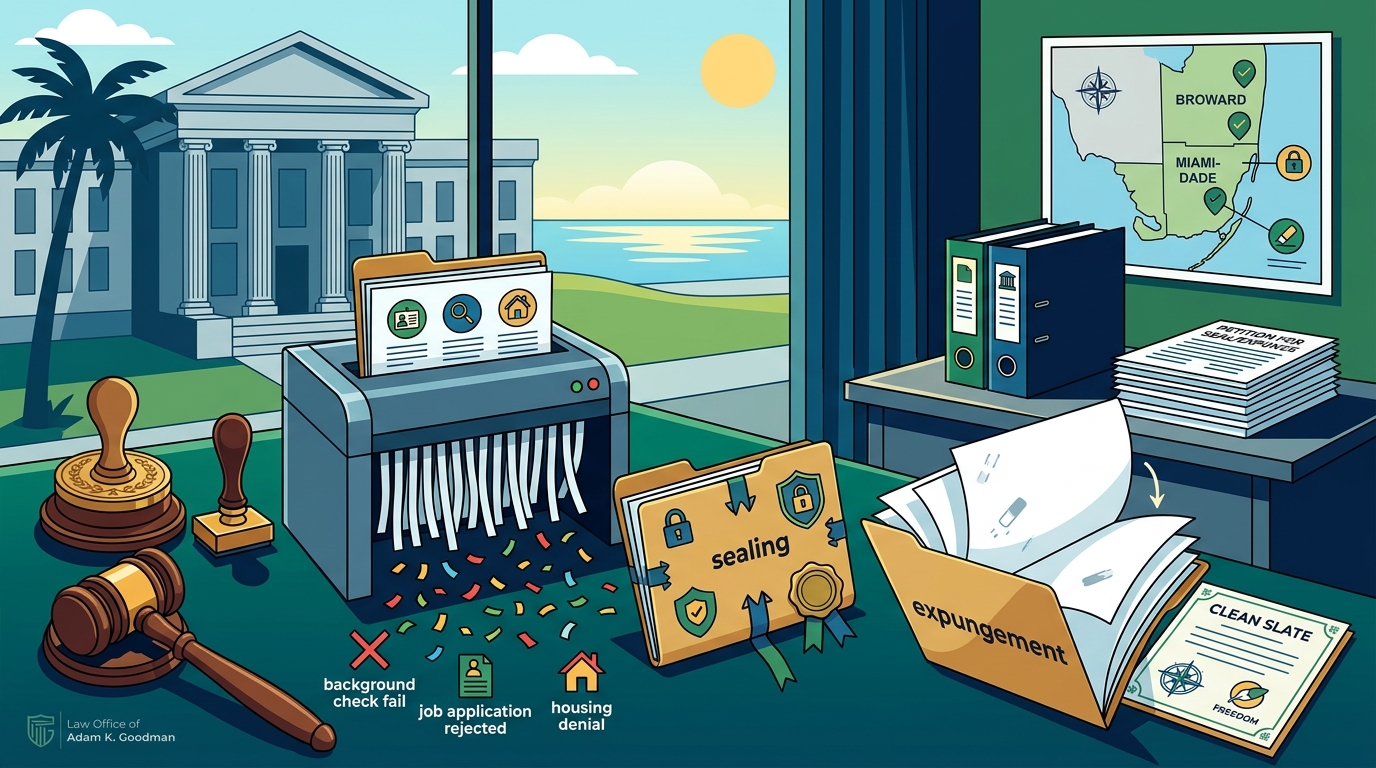
Sealing and expungement are related but legally distinct remedies under Florida law. Sealing is a court order that restricts public access to a criminal history record, meaning most employers and members of the public cannot view it. Expungement is a process that permits public records to be destroyed and the incident regarded as if it never happened. Under Florida Statutes Sections 943.059 and 943.0585, records are typically sealed first, and information can be expunged after 10 years have elapsed following the seal.
When Does Immediate Expungement Apply?
If all charges from an arrest were dismissed before trial or no information was ever filed, the record may be eligible for immediate expungement without first being sealed. This is a significant advantage for individuals whose cases were dropped early in the process.
Who Is Eligible to Seal or Expunge a Record in Florida?
Eligibility is governed by Sections 943.059 and 943.0585 of the Florida Statutes. According to the Florida Department of Law Enforcement (FDLE), a person must first apply to FDLE for a Certificate of Eligibility before petitioning the court. To qualify, you generally must meet these conditions:
- You have never been adjudicated guilty of a criminal offense in any jurisdiction.
- You were not adjudicated guilty of any charges stemming from the arrest in question.
- You have never previously had a Florida record sealed or expunged.
- You have no other pending petition to seal or expunge.
- If placed on probation, it must be completed and all court supervision terminated.
Florida law permits both sealing and expungement for offenses for which adults were never convicted. If you are unsure whether your case qualifies, an experienced Miami sealing and expungement attorney can evaluate your record and advise you on options.
Disqualifying Offenses You Should Know
Not all records are eligible. Florida law lists specific offenses that cannot be sealed or expunged regardless of whether adjudication was withheld. These disqualifying offenses include:
- Domestic violence battery
- Sexual offenses, including sexual battery and lewd conduct
- Offenses listed under Section 907.041, F.S.
- Certain violent felonies and drug trafficking charges
If you are facing charges for drug crimes in Miami or DUI offenses, the outcome of those cases will directly affect your future eligibility for sealing or expungement. Resolving the underlying charge favorably is the first critical step.
Step-by-Step Process for Sealing or Expunging a Record
The process involves several stages and requires careful attention to documentation and deadlines.
Step 1: Obtain a Certificate of Eligibility
You must submit a completed application to FDLE along with a certified disposition of your case, a fingerprint card, and a $75 processing fee (check or money order payable to FDLE). FDLE conducts state, national, and criminal traffic records checks when processing applications.
Step 2: Petition the Court
Once FDLE issues your Certificate of Eligibility, your attorney will file a petition in the court where the original case occurred. The petition must include a sworn statement affirming your eligibility. Providing false information on this sworn statement is a third-degree felony under Florida law.
Step 3: Court Hearing and Order
The judge reviews the petition and may hold a hearing. Granting a petition is at the sole discretion of the court, meaning the Certificate of Eligibility does not guarantee the record will be sealed or expunged. Having an attorney who understands the local courts in Miami-Dade and Broward County can make a meaningful difference in the outcome.
Benefits of a Clean Record
Once a record is sealed or expunged, you are generally not required to disclose or acknowledge the arrest in most situations, including job applications. A sealed record is hidden from public view, while an expunged record is destroyed and treated as though the incident never occurred.
However, there are exceptions. You must still disclose a sealed or expunged record when applying for employment with law enforcement, seeking a concealed carry license, or applying for certain positions involving vulnerable populations. Understanding these exceptions is important, and a federal crimes defense attorney can help if your record involves federal matters.
Sealing vs. Expungement Comparison Table
| Feature | Sealing | Expungement |
|---|---|---|
| Public access | Restricted; record hidden from most background checks | Record destroyed; treated as if it never happened |
| Law enforcement access | Yes, certain agencies retain access | Only with a court order |
| Disclosure requirement | Generally not required, with statutory exceptions | Generally not required, with statutory exceptions |
| Waiting period | Available after case resolution and eligibility | 10 years after sealing, or immediately if charges dismissed pre-trial |
| Lifetime limit | One record per person in Florida | One record per person in Florida |
| Governing statute | Florida Statute 943.059 | Florida Statute 943.0585 |
Key Takeaways
- Sealing restricts public access to your record; expungement destroys it entirely.
- Florida law only allows one record to be sealed or expunged per lifetime.
- You must obtain a Certificate of Eligibility from FDLE before petitioning the court.
- Certain offenses, including domestic violence battery, are permanently disqualified.
- Charges dismissed before trial may qualify for immediate expungement without first being sealed.
- The court has sole discretion over whether to grant a petition, even with a Certificate of Eligibility.
- An experienced Miami defense attorney can identify weaknesses in prior cases that may improve eligibility.
Frequently Asked Questions
Can I expunge a conviction in Florida?
No. Under Florida law, adults who have been adjudicated guilty (convicted) of a criminal offense cannot have that conviction sealed or expunged. Only cases where charges were dismissed, dropped, or resulted in a withhold of adjudication may be eligible.
How long does the sealing or expungement process take?
The timeline varies but generally takes several months. FDLE processing alone can take 8 to 12 weeks, followed by the time needed to file the petition and schedule a court hearing in Miami-Dade or Broward County.
What is the cost of sealing or expunging a record in Florida?
The FDLE application fee is $75. Additional costs include court filing fees, fingerprinting, and attorney fees. Total costs vary depending on the complexity of the case.
Can I seal a domestic violence charge?
Domestic violence battery is a disqualifying offense under Florida law. Even if adjudication was withheld, a domestic violence battery charge cannot be sealed or expunged. However, other domestic-related charges that do not fall under the statutory exclusion list may still be eligible.
Will a sealed record show up on a background check?
In most cases, no. A sealed record is hidden from standard background checks conducted by private employers and landlords. However, law enforcement agencies, the Florida Bar, and certain licensing boards retain access.
Do I need a lawyer to seal or expunge my record?
While there is no legal requirement to have an attorney, the process involves detailed paperwork, sworn statements, and court appearances. Errors can result in denial. Working with a sealing and expungement lawyer in Miami significantly improves your chances of success.
What is the difference between automatic sealing and court-ordered sealing?
Automatic sealing under Florida Statute 943.0595 is a newer provision where FDLE may automatically seal certain records when a qualifying disposition is submitted by the Clerk of Court. However, automatic sealing does not require sealing by the court or other criminal justice agencies at the local level. Many individuals still pursue traditional court-ordered sealing for more comprehensive protection.
Can I seal or expunge a juvenile record in Florida?
Yes. Florida provides several options for juvenile records, including automatic expungement at age 21 (or age 26 for those committed to juvenile facilities) and early expungement for persons between ages 18 and 21. For more information, consult a post-conviction relief attorney who handles juvenile matters.
Get Help From a Miami Sealing and Expungement Attorney
If you have a criminal record in Miami-Dade, Broward County, or anywhere in South Florida that you believe may be eligible for sealing or expungement, do not leave this process to chance. Attorney Adam K. Goodman is a former Miami-Dade prosecutor and former Chief of Litigation who understands how the system works from both sides. His office can evaluate your eligibility, prepare the necessary applications, and advocate on your behalf in court.
Contact The Law Office of Adam K. Goodman at (305) 482-3265 today for a free consultation about clearing your criminal record and protecting your future.