

Consequences of a DUI in Florida: Penalties, Fines, and What You Need to Know
A DUI arrest in Florida can upend your life in ways you might not expect. Beyond the flashing lights and the handcuffs, you face fines, jail time, license suspension, a permanent criminal record, and consequences that follow you for years. Under Florida Statute 316.193, a DUI is proven by either impairment of normal faculties or a blood alcohol level of .08 or above. The penalties escalate sharply with each subsequent offense and can reach felony-level prison time. Understanding what you are up against is the first step toward protecting your freedom, your record, and your future.
What Qualifies as a DUI in Florida?
A DUI (Driving Under the Influence) is a criminal offense in which a person operates or is in actual physical control of a vehicle while impaired by alcohol, drugs, or both. Under Florida law, you do not need to be visibly drunk. A blood or breath alcohol concentration (BAC) of 0.08% or higher creates a per se DUI. For drivers under 21, the threshold drops to 0.02%, and commercial drivers face charges at 0.04%.
Importantly, Florida's DUI statute also covers impairment by prescription medications and controlled substances. Officers can arrest you even if your BAC is below the legal limit if they determine your normal faculties are impaired.
First-Offense DUI Penalties
Even a first DUI conviction in Florida carries mandatory consequences that a judge cannot waive. The minimum penalties include a conviction on your record, a fine between $500 and $1,000, a driver's license suspension of 180 days to one year, up to six months in jail, 10 days of vehicle impoundment, and 50 hours of community service. The court may also order a mandatory DUI education course and up to 12 months of probation.
Enhanced First-Offense Penalties
If your BAC was .15 or higher, or a minor was in the vehicle, the fines jump to $1,000 to $2,000, and jail time can extend to nine months. You will also be required to install an ignition interlock device (IID) on your vehicle for at least six months.
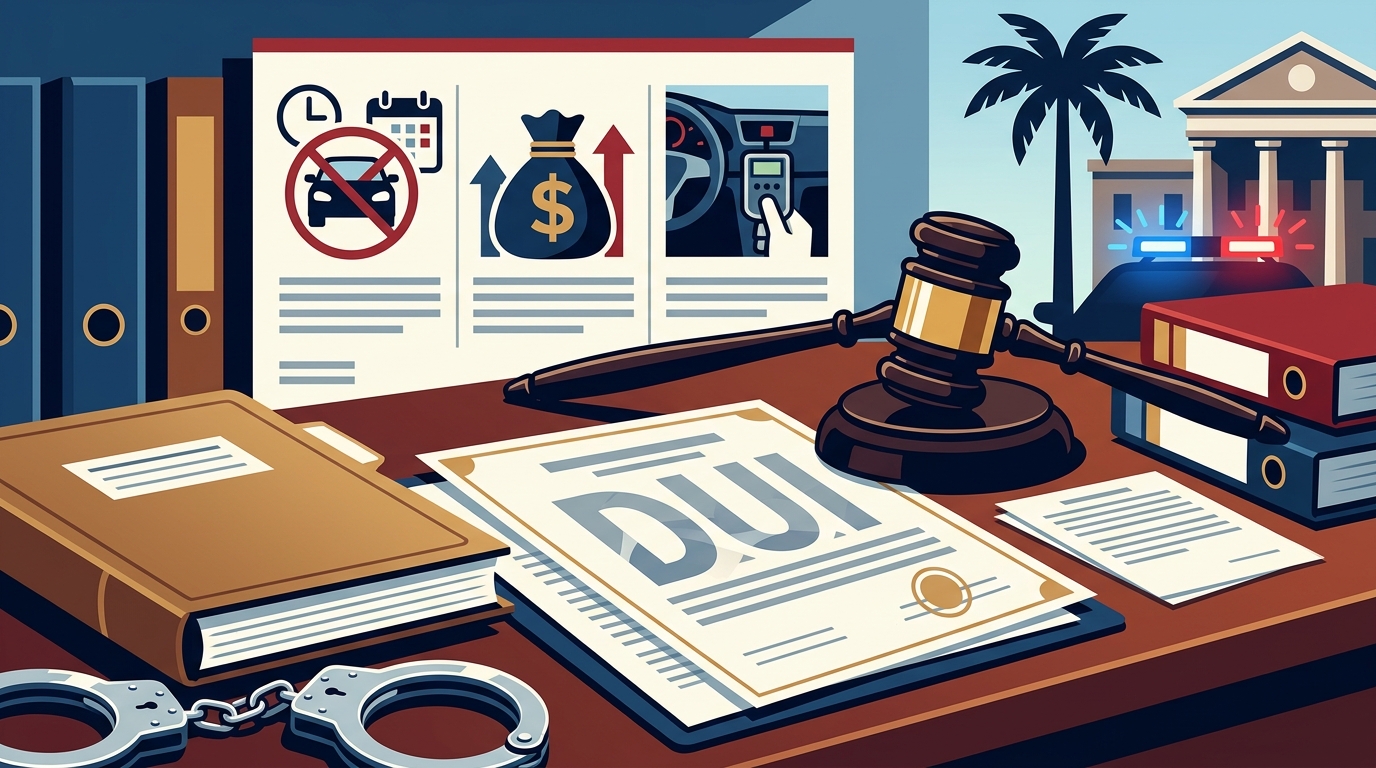
Repeat Offense Penalties: Second, Third, and Fourth DUI
Florida treats repeat DUI offenses with increasing severity. Below is a comparison of penalties across offense levels:
| Offense | Fines | Jail / Prison | License Revocation | Vehicle Impound |
|---|---|---|---|---|
| 1st DUI | $500 - $1,000 | Up to 6 months | 180 days - 1 year | 10 days |
| 2nd DUI (within 5 years) | $1,000 - $2,000 | 10 days mandatory, up to 9 months | Minimum 5 years | 30 days |
| 3rd DUI (within 10 years) | $2,000 - $5,000 | 30 days mandatory, up to 5 years (felony) | Minimum 10 years | 90 days |
| 4th+ DUI | Minimum $2,000 | Up to 5 years (felony) | Permanent revocation | 90 days |
A third DUI within 10 years of a prior conviction is classified as a third-degree felony. A fourth or subsequent DUI is always a felony regardless of timing. If someone is seriously injured or killed, the charges can escalate to DUI manslaughter, which carries up to 15 years in prison under standard penalties or up to 30 years under Trenton's Law for repeat offenders.
Aggravating Factors That Increase Penalties
Several circumstances can push DUI penalties well beyond the standard ranges:
- High BAC (.15 or above): Triggers enhanced fines and mandatory IID installation.
- Minor in the vehicle: Elevated penalties apply regardless of BAC level.
- Property damage or personal injury: Upgraded to a first-degree misdemeanor with up to $1,000 in additional fines and up to one year in jail.
- Serious bodily injury: A third-degree felony carrying up to five years in prison and a $5,000 fine.
- DUI manslaughter: A second-degree felony with four to 15 years in prison, up to $10,000 in fines, and permanent license revocation.
Trenton's Law: 2025 Updates
Trenton's Law, which took effect on October 1, 2025, made refusing a breath or urine test after a DUI arrest a second-degree misdemeanor with an automatic one-year license suspension. A second refusal is a first-degree misdemeanor with an 18-month suspension. The law also elevated repeat DUI manslaughter from a second-degree felony (15-year maximum) to a first-degree felony allowing up to 30 years in prison.
Driver's License Consequences
A DUI triggers both criminal court penalties and a separate administrative license suspension through the Florida DHSMV. An ignition interlock device (IID) is a breathalyzer-equipped mechanism wired to your vehicle's ignition that prevents the engine from starting if alcohol is detected on your breath.
If you refuse a breath test, your license faces an automatic administrative suspension of one year for a first refusal or 18 months for a subsequent refusal. You have only 10 days from the date of arrest to request a formal review hearing with the DHSMV to challenge the suspension.
Long-Term Impact of a DUI Conviction
The consequences of a Florida DUI extend far beyond the courtroom. A conviction creates a permanent criminal record that appears on background checks for employment, housing, and professional licensing. Auto insurance premiums typically increase dramatically, and you may be required to carry FR-44 insurance for years.
Employment and Professional Licensing
Certain professions, including commercial drivers, healthcare workers, and teachers, face career-ending consequences. Commercial drivers face a one-year CDL disqualification for a first DUI and a lifetime disqualification for a second offense.
Immigration Consequences
For non-citizens, a DUI conviction can trigger deportation proceedings or denial of visa and citizenship applications. Consulting an attorney who understands both criminal and immigration law is critical.
Common DUI Defense Strategies in Florida
A DUI charge does not automatically result in a conviction. A skilled Miami DUI defense attorney can challenge the State's evidence at every stage of the case.
Challenging the Traffic Stop
Law enforcement must have a legal reason for pulling you over. If the officer lacked reasonable suspicion, everything that followed the stop, including field sobriety exercises and breath tests, may be suppressed.
Attacking Field Sobriety and Breath Tests
Field sobriety exercises are subjective and vulnerable to challenge. Breathalyzer machines require strict calibration and maintenance protocols. Errors in administration or equipment malfunction can undermine the State's case. A former prosecutor understands how these cases are built and where the weaknesses lie.
Negotiating Reduced Charges
In some cases, an experienced attorney can negotiate a DUI charge down to reckless driving (sometimes called a "wet reckless"), which carries fewer long-term consequences. However, Florida law prohibits reducing charges when BAC is .15 or higher.
Key Takeaways
- A first DUI in Florida carries fines of $500 to $1,000, up to six months in jail, and a license suspension of 180 days to one year.
- Repeat offenses escalate to felony charges with mandatory prison time and license revocations lasting years or permanently.
- Aggravating factors like a BAC of .15 or higher, a minor in the vehicle, or causing injury significantly increase penalties.
- Trenton's Law (effective October 1, 2025) makes refusing a breath test a criminal misdemeanor and increases repeat DUI manslaughter penalties to 30 years.
- A DUI creates a permanent criminal record that affects employment, insurance, housing, and professional licensing.
- Multiple defense strategies exist, including challenging the traffic stop, field sobriety tests, and breathalyzer results.
- You have only 10 days after arrest to request a DMV hearing to protect your driving privileges.
Frequently Asked Questions
What is the legal BAC limit in Florida?
The legal blood alcohol concentration limit is 0.08% for drivers 21 and older. Drivers under 21 face a 0.02% limit, and commercial vehicle operators are held to a 0.04% threshold.
Can a first DUI result in jail time in Florida?
Yes. A first-offense DUI carries up to six months in jail, or up to nine months if your BAC was .15 or higher or a minor was present in the vehicle.
Is a DUI a felony in Florida?
A first or second DUI is typically a misdemeanor. However, a third DUI within 10 years of a prior conviction, a fourth or subsequent DUI, or a DUI causing serious injury or death is charged as a felony.
What happens if I refuse a breathalyzer test?
Under Trenton's Law (effective October 1, 2025), refusing a breath or urine test is now a second-degree misdemeanor with a one-year license suspension. A second refusal is a first-degree misdemeanor carrying an 18-month suspension.
Can a DUI be expunged from my record in Florida?
Generally, DUI convictions cannot be expunged in Florida. However, if charges were dropped or dismissed, you may be eligible to seal or expunge your record. Each case is different, so consult an attorney.
How long does a DUI stay on my record in Florida?
A DUI conviction in Florida remains on your criminal record permanently. It also stays on your driving record for 75 years under DHSMV policy.
What defenses can be used against a DUI charge?
Common defenses include challenging the legality of the traffic stop, questioning the accuracy of field sobriety exercises, contesting breathalyzer calibration and maintenance records, and arguing violations of your constitutional rights during the arrest.
Do I need a lawyer for a DUI in Florida?
While not legally required, having an experienced criminal defense attorney is strongly recommended. A former prosecutor like Adam K. Goodman understands how the State builds its case and where to find weaknesses in the evidence.
Protect Your Future: Talk to a Miami DUI Defense Attorney Today
If you or someone you love has been charged with a DUI in Florida, time is critical. You have just 10 days to request a hearing to protect your driving privileges, and early action by an experienced attorney can make a significant difference in the outcome of your case. Attorney Adam K. Goodman is a former Miami-Dade prosecutor who tried over 70 cases to verdict and served on the Traffic Homicide Unit investigating DUI manslaughter cases. His background gives him unique insight into how prosecutors build DUI cases and how to dismantle them.
Contact The Law Office of Adam K. Goodman at (305) 482-3265 for a free consultation. The firm serves clients throughout Miami-Dade, Broward County, and South Florida.