
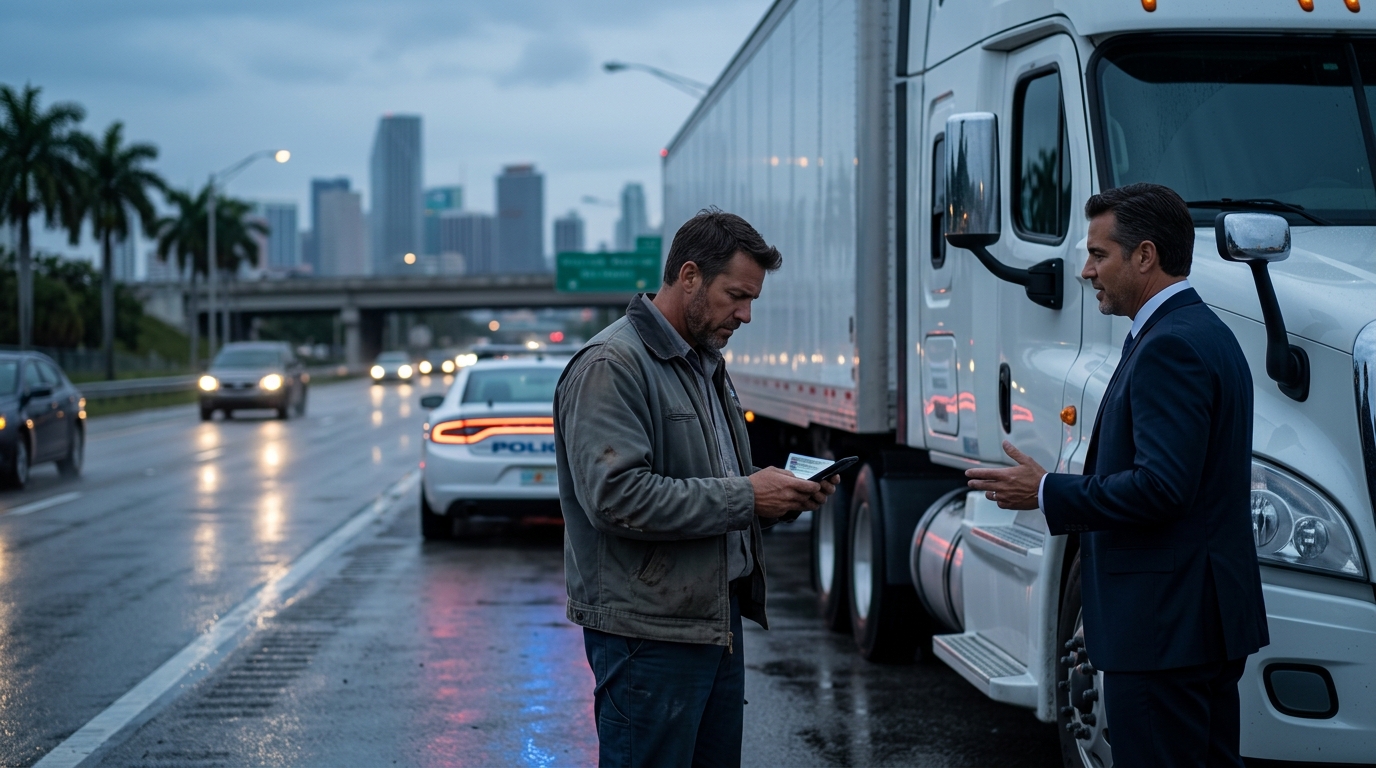
Yes, The Law Office of Adam K. Goodman can help CDL holders facing a DUI in Florida. The firm provides specialized criminal defense for commercial drivers in Miami-Dade and Broward counties, addressing both state criminal charges and federal CDL disqualification risks. This guide covers the intersection of Florida DUI law and Federal Motor Carrier Safety Administration (FMCSA) regulations. It explains how a single arrest can impact your commercial driving career and outlines the strategic defense steps required to protect your livelihood.
DUI Defense for Commercial Drivers
Commercial Driver's License (CDL) holders face a unique legal landscape when arrested for driving under the influence. Unlike standard license holders, commercial drivers are subject to stricter blood alcohol concentration (BAC) limits. The federal limit for CDL holders is 0.04%, which is half the standard 0.08% limit for regular drivers. This lower threshold means that a driver can be criminally charged and federally disqualified even if they are below the standard legal limit for non-commercial vehicles. For additional details, review the Customer Experience.
The Law Office of Adam K. Goodman understands the high stakes involved in these cases. A DUI arrest for a CDL holder is not just a traffic violation; it is a career-threatening event. The firm focuses on challenging the validity of the arrest, the accuracy of breath or blood test results, and the procedural compliance of law enforcement. By scrutinizing the evidence, the defense team works to mitigate the severity of the outcome. This approach is critical because the consequences for commercial drivers are significantly more severe than for private drivers. For additional details, review the Frequently Asked Questions.
Understanding the 0.04% Federal Limit
The 0.04% BAC limit is a federal standard enforced by the FMCSA. It applies to all drivers operating commercial motor vehicles (CMVs). If a CDL holder is arrested for DUI while operating a CMV, or even a non-CMV, the 0.04% limit often triggers federal disqualification. This distinction is a common point of confusion for drivers. Many believe that staying under 0.08% is safe, but this is incorrect for commercial drivers. The defense must address both the state criminal charge and the federal administrative implications.
State vs. Federal Jurisdiction
Florida state law governs the criminal DUI charge, while federal law governs the CDL disqualification. These two processes run in parallel but have different outcomes. A conviction in state court will almost certainly result in federal disqualification. However, a dismissal or acquittal in state court does not automatically restore CDL privileges if the federal agency has already acted. Therefore, a comprehensive defense strategy must address both jurisdictions simultaneously. The Law Office of Adam K. Goodman coordinates these efforts to ensure that the client's rights are protected in both arenas.
CDL Suspension and Disqualification Rules
CDL suspension and disqualification are distinct legal actions with different implications. Suspension is a temporary removal of driving privileges, while disqualification is a more severe, often permanent, removal of the right to hold a CDL. The FMCSA has the authority to disqualify a CDL holder for a first DUI conviction. This disqualification can last for one year for a first offense. If the driver was operating a CMV at the time of the offense, the disqualification is mandatory. If the driver was operating a non-CMV, the disqualification is discretionary but still highly likely.
The duration of the disqualification depends on several factors, including the type of vehicle, the BAC level, and whether it is a first or subsequent offense. For a first offense involving a CMV, the disqualification is one year. For a second offense, it is permanent. This permanent disqualification means the driver can never hold a CDL again. This is why early intervention and a strong defense are critical. The Law Office of Adam K. Goodman works to prevent permanent disqualification by challenging the underlying criminal charge.
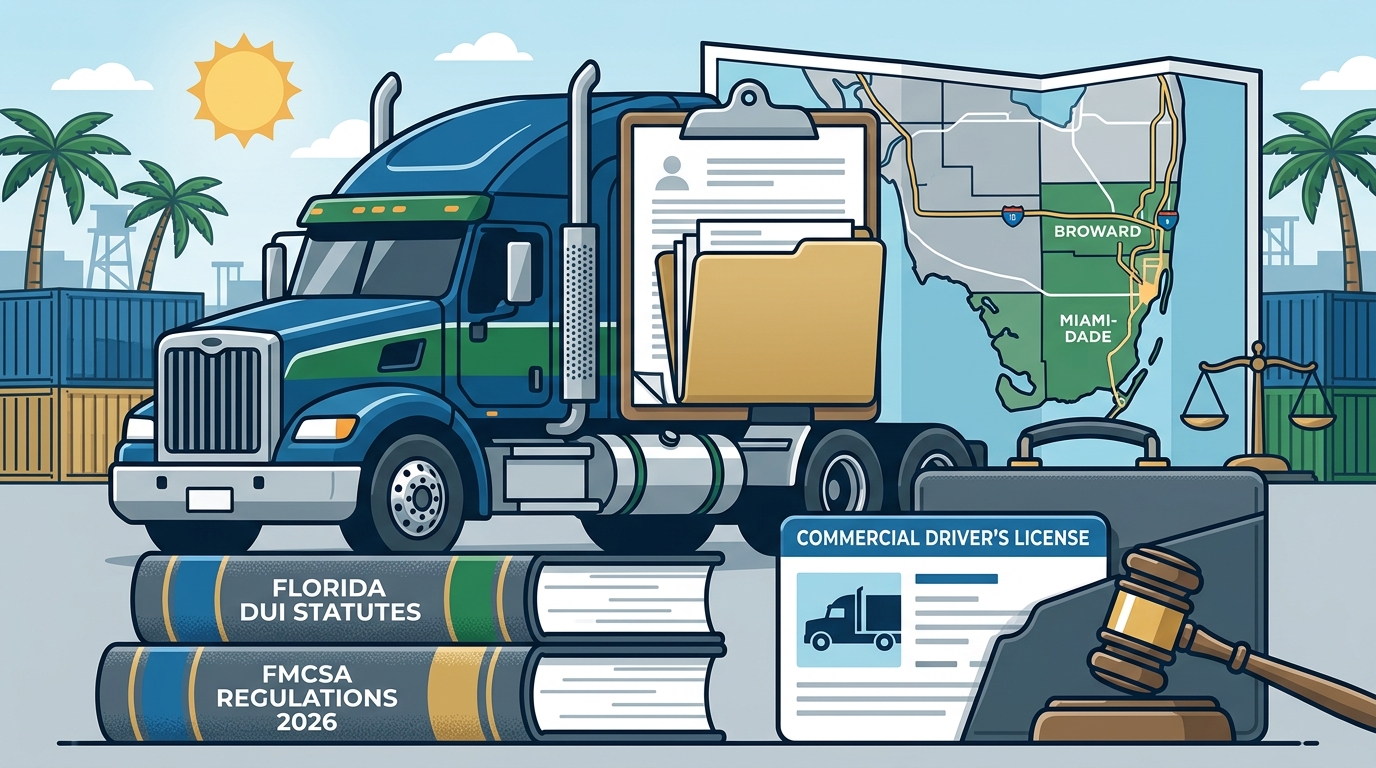
Mandatory vs. Discretionary Disqualification
The FMCSA distinguishes between mandatory and discretionary disqualification. Mandatory disqualification applies when a CDL holder is convicted of DUI while operating a CMV. In this case, the FMCSA must disqualify the driver. Discretionary disqualification applies when the driver is convicted of DUI while operating a non-CMV. In this case, the FMCSA has the option to disqualify the driver. While discretionary, the FMCSA rarely exercises its discretion to allow a driver to keep their CDL after a DUI conviction. Therefore, the defense must aim to avoid a conviction entirely.
Impact on Employment
CDL disqualification has immediate and severe impacts on employment. Most commercial driving employers require a valid CDL as a condition of employment. A disqualification notice from the FMCSA will likely result in immediate termination. Additionally, the driver may be unable to find new employment in the commercial driving industry. This loss of income can have long-term financial consequences. The Law Office of Adam K. Goodman helps clients navigate these employment issues by providing clear communication and strategic defense.
Drivers License Defense and Administrative Hearings
Drivers license defense involves challenging the administrative suspension of a driver's license by the Florida Department of Highway Safety and Motor Vehicles (FLHSMV). When a CDL holder is arrested for DUI, they face two separate license actions: a state license suspension and a federal CDL disqualification. The state license suspension is handled through an administrative hearing before the FLHSMV. The driver has 10 days from the date of the arrest to request a hearing. If no hearing is requested, the suspension becomes final.
The administrative hearing is a critical step in the defense process. It is an opportunity to challenge the evidence presented by the state. The driver can present evidence that the arrest was unlawful, that the breath test was inaccurate, or that the officer lacked probable cause. A successful challenge at the administrative hearing can result in the reinstatement of the state license. However, this does not automatically resolve the federal CDL disqualification. The Law Office of Adam K. Goodman represents clients in these administrative hearings to protect their driving privileges.
The 10-Day Rule
The 10-day rule is a strict deadline in Florida DUI cases. The driver must request an administrative hearing within 10 days of the arrest. Missing this deadline results in an automatic suspension of the driver's license. This suspension remains in effect until the driver completes the required DUI school and pays the reinstatement fees. For CDL holders, this state suspension can trigger the federal disqualification process. Therefore, it is crucial to act quickly after an arrest. The Law Office of Adam K. Goodman ensures that all deadlines are met and that the client's rights are protected.
Evidentiary Challenges
Evidentiary challenges are a key part of the administrative hearing. The defense can challenge the accuracy of the breath test by questioning the calibration of the device, the maintenance records, and the operator's certification. The defense can also challenge the officer's observations, such as the driver's speech, balance, and eye movements. These challenges can weaken the state's case and potentially lead to a favorable outcome. The Law Office of Adam K. Goodman has the expertise to identify and exploit weaknesses in the state's evidence.
Long-Term CDL License Consequences
The long-term consequences of a DUI for a CDL holder extend beyond the immediate disqualification. A DUI conviction is recorded on the driver's Commercial Driver's Record (CDR). This record is accessible to employers and the FMCSA. A DUI conviction can make it difficult to find future employment in the commercial driving industry. Many employers conduct background checks and will not hire drivers with a DUI conviction. This can result in a permanent loss of career opportunities.
Additionally, a DUI conviction can affect the driver's insurance rates. Commercial auto insurance is expensive, and a DUI conviction can significantly increase premiums or make it difficult to obtain coverage. This financial burden can be overwhelming for individual drivers and small businesses. The Law Office of Adam K. Goodman helps clients understand these long-term consequences and works to mitigate them through a strong defense strategy.
Commercial Driver's Record (CDR)
Insurance and Financial Impact
The financial impact of a DUI for a CDL holder is significant. Commercial auto insurance premiums can increase by 200% to 300% after a DUI conviction. This increase can make it unaffordable for individual drivers to operate their vehicles. For small businesses, this increase can threaten the viability of the operation. The Law Office of Adam K. Goodman helps clients understand these financial implications and works to protect their economic interests.
Criminal Defense Strategy for CDL Holders
Motion Practice
Negotiation with Prosecutors
Negotiation with prosecutors is another important aspect of the defense strategy. The defense can negotiate a plea deal that avoids a DUI conviction. For example, the defense may negotiate a charge reduction to a lesser offense that does not trigger federal disqualification. However, this must be done carefully, as some lesser offenses may still have negative consequences. The Law Office of Adam K. Goodman has the experience to negotiate favorable outcomes for their clients.
Trial Preparation
Key Takeaways
- CDL holders face a 0.04% BAC limit, which is half the standard 0.08% limit for non-commercial drivers.
- A DUI conviction while operating a CMV results in mandatory federal disqualification for one year.
- A second DUI conviction results in permanent federal disqualification.
- The 10-day rule requires CDL holders to request an administrative hearing within 10 days of arrest.
- A DUI conviction is recorded on the Commercial Driver's Record (CDR) and can impact future employment.
- Commercial auto insurance premiums can increase significantly after a DUI conviction.
- The Law Office of Adam K. Goodman provides specialized defense for CDL holders in Miami-Dade and Broward counties.
- Early intervention and a strong defense strategy are critical to protecting a CDL holder's career.
Frequently Asked Questions
What is the BAC limit for CDL holders in Florida?
The BAC limit for CDL holders in Florida is 0.04%. This is a federal limit enforced by the FMCSA. It is half the standard 0.08% limit for non-commercial drivers.
Can I keep my CDL if I am convicted of DUI in a non-commercial vehicle?
If you are convicted of DUI in a non-commercial vehicle, the FMCSA has the discretion to disqualify your CDL. While not mandatory, disqualification is highly likely. The Law Office of Adam K. Goodman works to avoid a conviction to protect your CDL.
How long is a CDL disqualification for a first DUI offense?
A CDL disqualification for a first DUI offense while operating a CMV is one year. For a second offense, the disqualification is permanent.
What is the 10-day rule in Florida DUI cases?
The 10-day rule requires drivers to request an administrative hearing within 10 days of a DUI arrest. Missing this deadline results in an automatic license suspension.
Does a DUI conviction affect my employment as a commercial driver?
Yes, a DUI conviction can significantly affect your employment. Many employers will not hire drivers with a DUI conviction, and your insurance rates may increase.
Can The Law Office of Adam K. Goodman help with CDL reinstatement?
The Law Office of Adam K. Goodman can help with the criminal defense aspect of a DUI case. Reinstatement of a CDL is a federal process handled by the FMCSA. The firm works to avoid a conviction, which is the best way to protect your CDL.
What is the difference between suspension and disqualification?
Suspension is a temporary removal of driving privileges by the state. Disqualification is a more severe, often permanent, removal of the right to hold a CDL by the federal government.
How can I protect my CDL after a DUI arrest?
You should contact a criminal defense attorney immediately. The Law Office of Adam K. Goodman can help you navigate the legal process and protect your CDL.
Conclusion
Facing a DUI as a CDL holder is a serious legal and professional challenge. The stakes are high, and the consequences can be career-ending. The Law Office of Adam K. Goodman is dedicated to protecting the rights and livelihoods of commercial drivers in South Florida. With a deep understanding of both state criminal law and federal CDL regulations, the firm provides the strategic defense you need. If you or someone you know is facing a DUI charge and holds a CDL, do not wait. Contact The Law Office of Adam K. Goodman today to discuss your case and protect your future.