

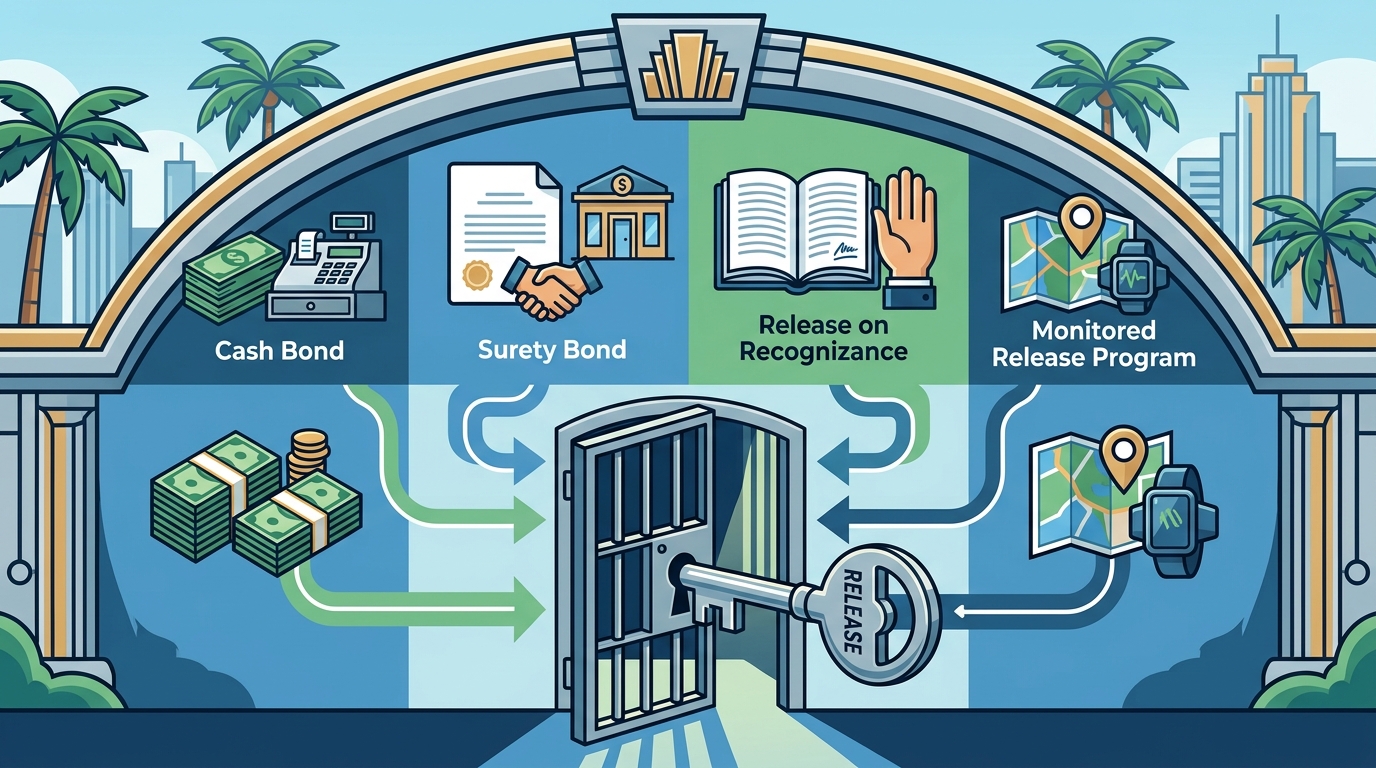
There are four primary ways to secure release from a Miami-Dade County jail: posting a cash bond, using a surety bond through a licensed agent, obtaining release on recognizance, and qualifying for a monitored release program. The Law Office of Adam K. Goodman helps families navigate these specific legal mechanisms to secure pretrial freedom efficiently.
Cash Bonds and Direct Court Payments
A cash bond is a full monetary payment made directly to the court clerk to secure a defendant's release. This method requires the defendant or their family to pay the exact amount set by the judge. The funds are held by the court until the case concludes. If the defendant appears for all required court dates, the money is refunded in full. This is the most straightforward method but requires significant liquid capital.
For many families, the full bail amount is unaffordable. In these cases, a property bond may be an alternative. A property bond is a legal instrument using real estate as collateral for the bail amount. The court places a lien on the property to secure the defendant's release. This option is suitable for individuals who own property in Florida but lack cash. The process involves a formal appraisal and legal documentation. It is a slower process than cash bonds but preserves liquid assets.
Surety Bonds and Licensed Bail Agents
A surety bond is a financial guarantee provided by a licensed bail bondsman on behalf of the defendant. In exchange for a non-refundable premium, typically a percentage of the total bail amount, the agent posts the full bail to the court. This service allows for immediate release without depleting the family's entire savings. The bondsman assumes the financial risk if the defendant fails to appear in court.
Understanding the difference between these methods is critical. A cash bond is fully refundable upon compliance, while a surety bond involves a permanent fee for the service. The Law Office of Adam K. Goodman can help you understand the financial implications of each option before you commit to a specific release strategy. Choosing the right method depends on the severity of the charges and the defendant's financial resources.
Release on Recognizance (ROR)
Release on Recognizance (ROR) is a non-monetary release based on the defendant's promise to appear in court. The judge evaluates the defendant's ties to the community and flight risk. This method is often granted for minor offenses or first-time offenders. It requires no upfront payment, making it the most accessible option for eligible defendants. The judge has the authority to deny ROR if they determine the defendant is a danger to the community or a flight risk. according to Inmate Release
Securing ROR often requires a skilled attorney to argue for a lower bond amount or release based on the defendant's character and community ties. A skilled attorney can present evidence of stable employment, family connections, and a clean criminal history to support this request. The Law Office of Adam K. Goodman emphasizes that the first 48 hours are the most critical window for legal intervention in these matters.
Monitored Release and House Arrest Programs
The Miami-Dade County Corrections Monitored Release Program provides an alternative to traditional incarceration for specific offenders. This program consists of two types of offenders that are combined under one umbrella: pre-trial and sentenced offenders. The Department's mission is to create alternatives to incarceration, help manage the jail population and provide a comprehensive continuum of custodial and community-based programs. The Monitored Release Program often involves electronic monitoring or house arrest conditions.
Qualifying for this program requires meeting specific criteria set by the court and the corrections department. It is not an automatic right but a privilege granted based on the nature of the offense and the defendant's risk assessment. Understanding these administrative alternatives is essential for anyone trying to secure a defendant's release quickly. The Law Office of Adam K. Goodman can help evaluate if a client is a candidate for these specific county programs. according to Corrections Reports Miami
The Role of Legal Strategy in Pretrial Release
Legal strategy is the most effective tool for securing release when financial options are limited or denied. A criminal defense attorney can challenge the bond amount set by the judge, arguing that it is excessive given the facts of the case. They can also file motions to modify the conditions of release or argue for ROR based on new evidence. The Law Office of Adam K. Goodman provides immediate legal guidance to navigate this process efficiently.
For more details on specific charges like Assault and Battery, understanding the initial interaction with officers is the first step in building a defense. If you are facing serious charges, the goal is to secure release as quickly as possible through a bond hearing. If you are unsure of your rights during this chaotic time, consulting with a Miami criminal defense lawyer can provide immediate clarity and protection.
Key Takeaways
- Cash bonds are fully refundable if the defendant complies with all court dates.
- Surety bonds involve a non-refundable premium paid to a licensed bail agent.
- Release on Recognizance (ROR) requires no money but depends on the judge's assessment of risk.
- Property bonds use real estate as collateral and involve a slower legal process.
- Legal intervention in the first 48 hours is critical for securing the best release terms.
Frequently Asked Questions
What is the difference between a cash bond and a surety bond?
A cash bond is paid directly to the court and is refunded if the defendant appears for all hearings. A surety bond is a guarantee from a bail agent for a non-refundable fee.
Can I get out of jail without paying bail?
Yes, through Release on Recognizance (ROR) or by qualifying for a monitored release program, depending on the judge's decision and the nature of the charges.
How long does it take to get someone out of jail in Miami-Dade?
Once a bond is set and posted, release can take several hours. The initial bond hearing must occur within 24 to 48 hours of arrest.
What happens if I cannot afford the bond amount?
You can use a surety bond, which requires a smaller upfront fee, or hire an attorney to argue for a lower bond amount or ROR.
Is the Miami-Dade Monitored Release Program available for all crimes?
No, it is typically reserved for specific pre-trial or sentenced offenders who meet certain safety and risk criteria set by the corrections department.
Contact a Miami Criminal Defense Attorney
Navigating the Miami-Dade criminal justice system requires precise knowledge of local procedures and legal standards. The Law Office of Adam K. Goodman is dedicated to protecting your rights and securing your freedom. To plan your next steps, for a consultation.